

How to Care for Your Countertop: 6 Questions for Everneat
A countertop lives through years of daily use, and we want it to keep looking good. Good countertop care is what makes that possible, yet most of what we think of as "clean" was taught to us by 30-second commercials, not by what actually protects a surface.
So Barbra Fordyce, founder of Ginger Lemon Indigo in Westport, Connecticut, sat down for a coffee with cleaning expert Claudia Zimmerman. Claudia, a trained architect, founded Everneat, a probiotic-based cleaning line one town over in Fairfield; she also runs a professional cleaning company that has taken care of more than 10,000 homes. That makes this a conversation from opposite ends of the same surface: one advises clients on which to choose, the other on how to care for it.
The six questions that follow are the ones clients raise with Barbra again and again, on nearly every kitchen project. Here, the two of them clear up the myths behind each one.
Their conversation, lightly edited for length.

1. Do You Need a Special Countertop Cleaner, or Is Soap and Water Enough?
Barbra: Every surface seems to come with its own recommended bottle now. Is a dedicated countertop cleaner actually necessary, or is soap and water fine?
Claudia: Soap and water is genuinely fine for a light once-over, so don't let anyone tell you otherwise. Where a proper cleaner earns its place is consistency: it holds a neutral pH so it never etches stone, and its surfactant lifts grease rather than smearing it thinner. The tell of a good one is what it leaves behind, which is nothing. No film, no fragrance drifting into the next room.
“The tell of a good countertop cleaner is what it leaves behind: nothing.”
2. Can You Clean Marble or Granite with Vinegar?
Barbra: This is the one I hear most: people reach for vinegar because it's natural. Talk me through why that's a bad idea.
Claudia: Because it's the surest way to ruin a beautiful counter. Vinegar sits around pH 2.5. That acid dissolves the calcium carbonate in marble, limestone and travertine into a dull etch that no amount of buffing brings back (Natural Stone Institute). The rule I give every client is one number: pH 7 to 8. Below it, acids like vinegar and lemon etch stone and dry out wood. Above it, around pH 11 and up, ammonia and bleach strip the sealer and leave a haze. Only the middle is safe for daily use on stone, sealed concrete and wood.
The quiet culprit is glass cleaner grabbed for a fast wipe. Ammonia versions are alkaline and break down the sealer; alcohol versions are solvents that dissolve the sealer on stone and pull the finish out of wood. Alcohol even passes the pH test on paper, so it looks innocent while it does the damage.
3. Probiotic, Disinfectant or Soap: What Actually Keeps a Counter Clean?
Barbra: You built Everneat around probiotic cleaning, which most people have never heard of. What does it do that soap or bleach doesn't?
Claudia: Think of it as three different jobs. Soap lifts grease and then leaves, so you're clean but unprotected. Disinfectants like bleach wipe the surface sterile for a few minutes, then it recontaminates from the air and your hands, and daily use of disinfectant sprays and wipes is linked to asthma and dermatitis besides (Cureus, 2025). Probiotics take the long view: they leave behind friendly bacteria that occupy the surface so pathogens have nowhere to settle, a process called competitive exclusion. In one hospital study, that approach cut contamination and even lowered antibiotic-resistance genes. Polished stone looks smooth but has microscopic grooves where bacteria hide from a plain wipe. A probiotic reseeds those grooves each time, so you top up a healthy layer instead of resetting to zero.
4. What's the Right Way to Wipe Down a Kitchen Counter?
Barbra: Is there really a wrong way to wipe a counter? Most of us grab the nearest cloth and go.
Claudia: There is, and it's mostly about not spreading what you're trying to remove. Fold a microfiber cloth in half, then in half again: that gives you eight clean faces, the same trick hospital cleaners use to stop moving germs from one spot to the next. Clear crumbs and spills first with the damp side so you're not grinding grit into the stone. Spray the counter, never the cloth. Then wipe front to back in an S shape rather than circles, because circles drag dirt back over what you cleaned. Finish along the edges and seams, where grease collects. One more habit: keep a separate cloth color for the kitchen so it never meets the bathroom.
How Do You Get Stuck-On Grime Off Without Scratching?
Claudia: For baked-on grime, reach for a mild abrasive paste instead of scrubbing harder with spray. On flat sealed surfaces, tile, painted cabinets, porcelain, work it in with a cloth for a gentle buffing effect. On grout a paste is the point, because a liquid runs off the ridges while a paste stays put under the brush.
5. Which Countertop Materials Need More Than a Wipe?
Barbra: In our kitchen countertop materials guide, every surface came with a note about upkeep. Once someone has the neutral cleaner and the cloth, is any surface still asking for extra attention?
Claudia: Most are happy with exactly that. Two surfaces want a little more from you: stainless steel and wood.
How Do You Clean Stainless Steel Countertops Without Streaks?
Claudia: Stainless shows every fingerprint, and the fix is technique, not a special spray. Dust it dry first, because skipping that turns dust and cleaner into a smeared paste. Then spray, wipe damp along the grain, never across it, and buff dry with the grain before it can spot. Skip oil and silicone polishes; they attract dust and off-gas near food. The shine comes from the grain-direction buffing, not from any coating.
How Do You Clean and Oil a Butcher Block Countertop?
Claudia: Wood is the one surface you can sand and refinish rather than replace, and in return it asks for a monthly ritual. Day to day, wipe it with the neutral cleaner along the grain and keep it damp, not wet, since standing water is wood's real enemy. Once a month, two steps. First oil the grain with food-grade mineral oil: it's the right choice, not the one to fear, because it's inert, food-safe and won't go rancid the way olive or walnut oil does inside the wood (America's Test Kitchen). Flood it on, let it soak from twenty minutes to overnight, wipe off the excess. Second, seal with a thin coat of beeswax or carnauba board cream over the top, since wax repels water where oil can't. Oil feeds from within, wax protects from without, and neither replaces the other. Redo both the moment water stops beading and starts soaking in.
6. Does Vinegar and Baking Soda Actually Clean Anything?
Barbra: The internet is full of vinegar and baking soda hacks. Do they work?
Claudia: They each do a little on their own, but the famous combination is mostly theater. Mix them and the fizz you're watching is carbon dioxide escaping; what's left in the bottle is essentially salt water (Wirecutter). And on stone the vinegar half is actively harmful. If you want a genuine home remedy, a little baking soda made into a paste can lift a stain, gently, but skip the volcano.
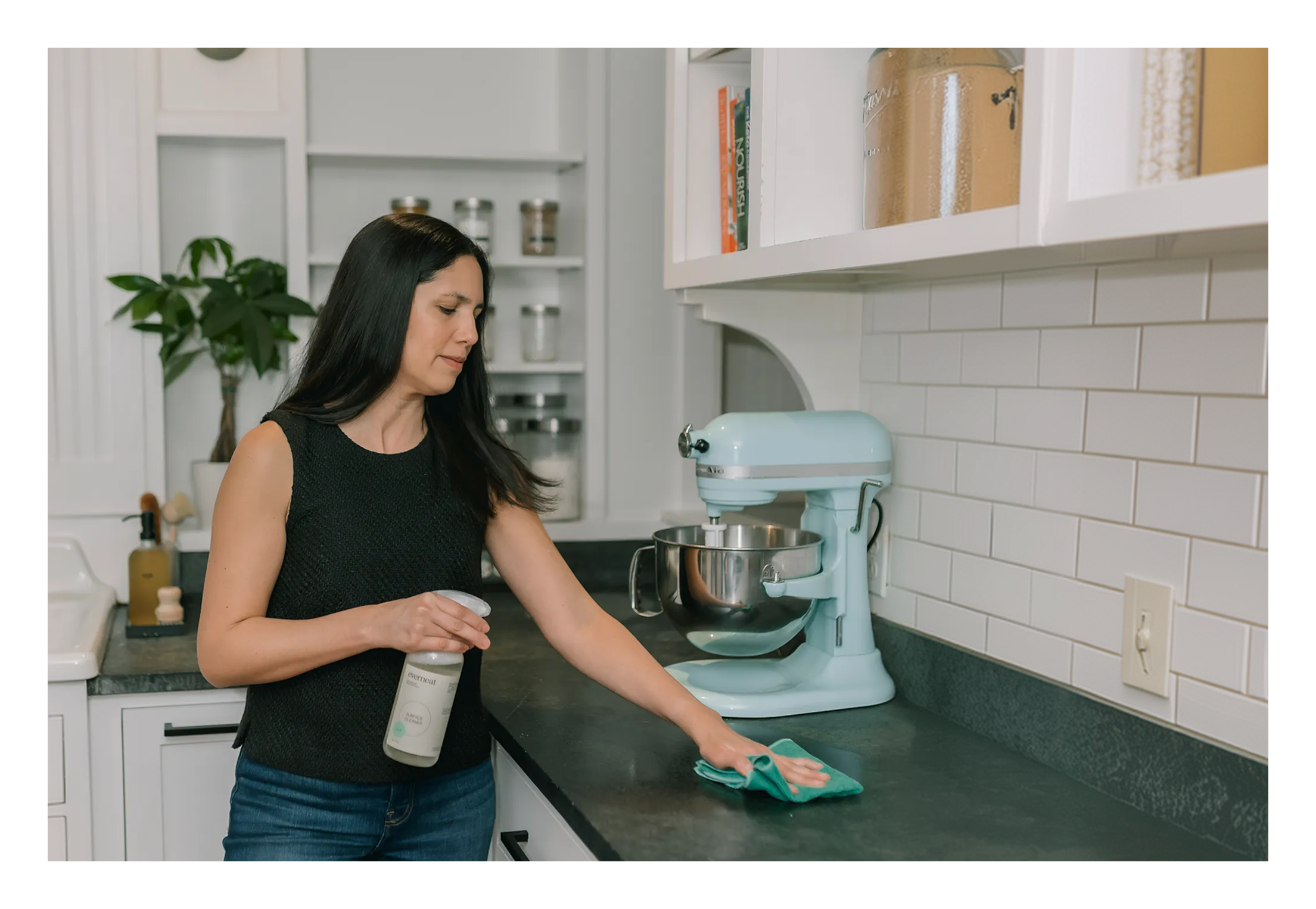
Claudia in her own kitchen, where soapstone counters take daily cooking in their stride. Photograph: Everneat
Three Short Questions Before You Go
Barbra: What is your own countertop at home?
Claudia: Soapstone, in a white kitchen. Not my first choice aesthetically, I'd love a lighter stone, but I'm glad it came with the house. Its resilience against stains, hot pans and scratches is unbeatable. We cook a lot, the kids too, so I never worry about the counters.
Barbra: So the lesson for anyone choosing?
Claudia: Don't pick a stone on looks alone. Ask whether it will make your daily life easy and maintenance-free.
Barbra: The habit you wish every home would adopt?
Claudia: A few minutes before bed clearing the kitchen, what I call the 9pm decision. Run the dishwasher, empty the sink, wipe the stove and countertops, and you wake up to a clean cooking space at breakfast. It keeps pests away, too.
Countertop Care Comes Down to One Bottle and Better Habits
Countertop care asks far less of you than the cleaning aisle suggests: one neutral cleaner, a well-folded cloth, and one or two habits matched to your surface. That routine protects the surface you invested in, and the people who gather around it. Claudia's probiotic sprays and pastes are the thinking behind much of this advice, and you can explore the full Everneat range at everneat.co.
If the choice of surface is still ahead of you, our kitchen countertop materials guide helps you find the right fit, and our modern condo in Rye, NY shows a quartz island holding its own in daily use. If a larger kitchen project is on your mind, we'd love you to get in touch and share your vision for your home.
Additional sources: Caselli et al., PLOS ONE, 2016; Whitehead et al., 2010; Wetrok, Folding Technique; Apartment Therapy, The "S" Technique.