

Sustainable Interior Design: Designing with Intention
Sustainable interior design focuses on creating spaces that are healthier to live in, longer-lasting, and less demanding on the planet — without trading away comfort, character, or beauty. At its core, it is a way of making decisions: which materials and products you choose, where and how products are made and what the lifespan is.
For Barbra Fordyce, founder of Ginger Lemon Indigo, sustainability has always been woven into her design work. Her earlier training in the life sciences gave her an understanding of the impact of materials: what they are made of, how they behave over time, and what they release into the spaces where families actually live. That carries into every project, from a mudroom renovation in Darien to a full home refresh on the Connecticut coast.
What Sustainability Means in Interior Design
Sustainable interior design means choosing materials, finishes, and furnishings that are less harmful across their full life, from extraction and production to daily use and eventual disposal. It addresses three interconnected concerns: environmental impact, occupant health, and durability.
Those three threads are rarely separated in practice. A reclaimed oak beam is lower in embodied carbon than new timber, but it also brings warmth and patina that a newly milled piece simply does not have. A low-VOC paint protects indoor air quality, but it also tends to have a depth and finish that holds up better over time. Good sustainable choices are often just good design choices, guided by a fuller understanding of the home, the materials, and how the space will be used.
The Materials That Matter Most
Sustainable interior design is about choices. These are the categories where material decisions make the most meaningful difference.
Paints and Finishes
Conventional paints release volatile organic compounds (VOCs) into the air for months after application. The EPA has found that VOC levels inside homes run 2 to 5 times higher than outdoors — a gap that widens considerably in the well-insulated, tightly sealed homes common across Fairfield County. Low-VOC and zero-VOC paints like a eco friendly Portola Lime wash are much better for the environment and our health. At Ginger Lemon Indigo, we try to make conscious choices.
Wood and Millwork
FSC-certified timber, certified by the Forest Stewardship Council, confirms that wood has been sourced from responsibly managed forests. Reclaimed timber carries no new harvesting footprint and brings a material history that no new product can replicate — though it rewards careful sourcing. Not every reclaimed piece is suited to every application, and knowing the difference is part of the work. For cabinetry, built-ins, and flooring, these are the first choices.
Textiles
Natural fibers like linen, wool, organic cotton — perform well, age honestly, and do not introduce the microplastic shedding associated with synthetic upholstery. Wool is particularly practical in family homes: it is naturally stain-resistant, durable, and biodegradable at the end of its life.
Flooring
Porcelain tile, Natural stone and responsibly-sourced solid wood are very durable, outlasting synthetic alternatives by decades. Longevity is itself a sustainability argument, a floor that lasts forty years requires no replacement and generates no landfill.
Designing for Longevity
Spaces designed around trends, or furnished with pieces chosen for a moment rather than a lifetime, generate enormous waste. A sectional that wears out in five years, a paint color chased from a magazine that feels dated before the next repaint, these are the quiet costs that add up.
Ginger Lemon Indigo designs with longevity as a starting condition. That means choosing timeless over trending, repairable over disposable, and specific over generic. It also means designing for how a family actually lives — so a mudroom handles a Connecticut winter gracefully, a family room absorbs real use without losing its composure, and a kitchen can grow with the household.
Sustainability also means working with a family's existing furniture wherever possible: a beloved piece, well-made and full of meaning, is almost always worth keeping. The most sustainable piece in a room is often the one that is already there — a principle Barbra explored in her Designeers interview on material honesty and sustainable practice.
Seen in Practice: The Darien Residence
A New England farmhouse in Darien, Connecticut offered a clear opportunity to put these principles to work across an antique, character-rich home.
What we've found, working in family homes across Fairfield County, is that the mudroom is where sustainable choices are either made or quietly abandoned — it's the most used space in the house, and the one where material decisions face the hardest daily test.
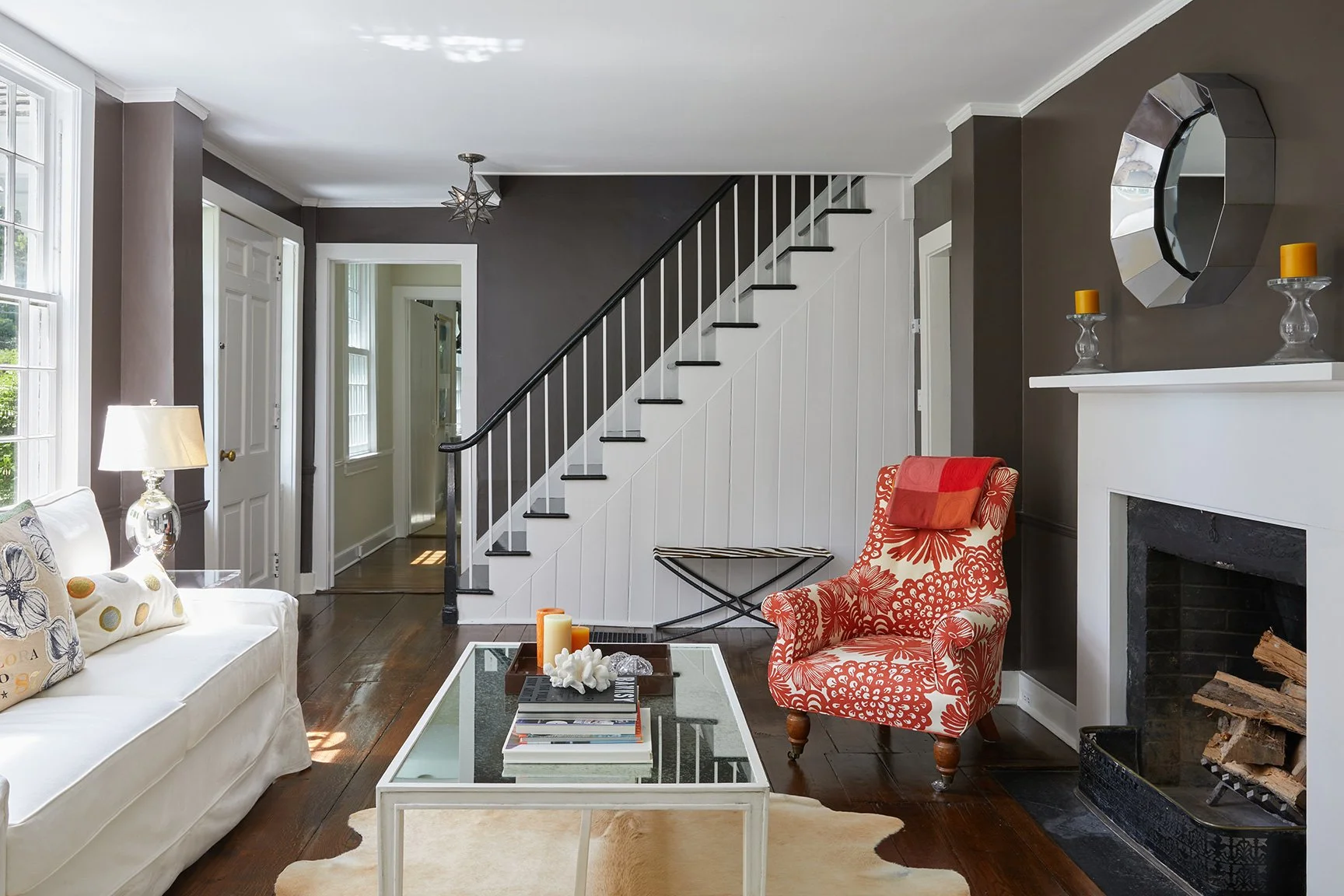
Throughout the rest of the house, sustainability showed up in quieter ways: a cream wool noodle rug in the family room, natural fiber textiles that breathe and wear, vintage and antique pieces given a second life rather than replaced with new. The family's existing furniture, an eclectic mix collected over time, was worked with, not around.
The result is a home that performs well, feels considered, and will not need to be redone in five years. See how those decisions came together in the Darien Residence.
Sustainable Design Produces Better Spaces
Low-VOC paints in muted, considered tones create more atmosphere than high-gloss synthetics. Reclaimed wood has a surface quality that new timber simply cannot match. Natural fiber textiles bring a warmth and texture that polyester blends approximate but never quite achieve. FSC-certified cabinetry, properly made, will outlast the trends that surround it.
Sustainability, applied where possible to other design decisions, produces spaces that are better to be in. Not stripped back. Not austere. Simply more thoughtful and more lasting.
Barbra Fordyce, an ASID Allied designer and founder of Ginger Lemon Indigo, trained at the New York School of Interior Design and works with homeowners across Fairfield County and the wider New York area — Darien, Westport, Greenwich, Southampton, and beyond. Her approach to sustainable interior design is the same as her approach to everything else: grounded in how a home is actually lived in and built to last.
If you're considering a renovation or a full redesign and want to talk through what a more considered approach might look like, we'd be glad to start that conversation.